
Many institutions treated ADA Title II updates as a website remediation sprint — while the materials students and citizens interact with daily (syllabi, forms, policy PDFs, LMS uploads) stayed out of scope until a review or complaint forced them in.
Title II readiness is really an accessibility compliance management problem across every content type — not a one-time web project. Documents are where most of the risk actually lives.
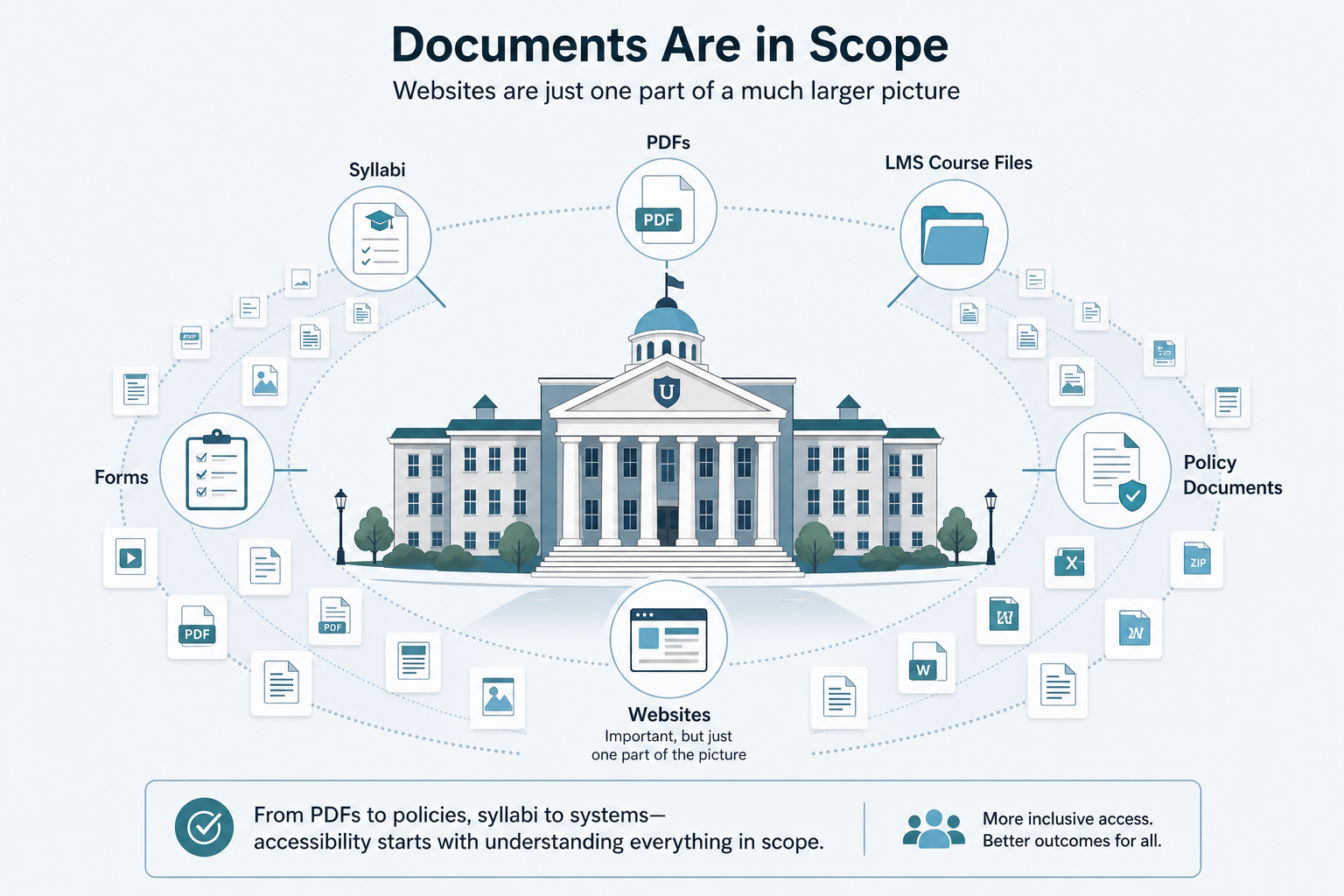
Title II scope extends beyond the homepage
State and local government entities — and public higher education institutions under Title II — must ensure effective communication and equal access to programs and services. That includes:
- Public-facing documents (notices, forms, reports)
- Instructional materials distributed through LMS platforms
- Internal policy libraries published to employees or students
- Third-party content integrated into official channels (vendor PDFs, licensed materials)
If it carries official program information, it is in scope.
The document gap institutions underestimate
Web accessibility reviews routinely surface WCAG issues on templates and navigation. They rarely inventory the thousands of PDFs in:
- Registrar and financial aid portals
- Faculty course shells
- Departmental shared drives mirrored to public sites
Morf's institutional work — rooted in 16+ years of NIH and NSF-funded research with universities — consistently finds that document volume outpaces web page count in education and the public sector.
A program-level readiness checklist
| Area | Question to answer |
|---|---|
| Inventory | Do you know how many public PDFs exist and where? |
| Standards | Are documents held to WCAG 2.2 AA / PDF/UA, not just web? |
| Workflow | Is there a transformation queue with ownership and SLAs? |
| Proof | Can you produce conformance documentation on request? |
| LMS | Are faculty uploads reviewed before or after distribution? |
A "yes" on web alone is not readiness.
Enforcement pressure is operational, not theoretical
Title II rulemaking and increasing regulatory attention shift accessibility from voluntary best practice to program accountability. Program leads need:
- Gap detection across content types
- Prioritized remediation queues
- Ongoing monitoring as content changes
This is governance work — not a one-time vendor project.
MorfAlign for institutional programs
MorfAlign tracks ADA Title II and Section 508 program readiness across transformation workflows — from detection through expert-reviewed delivery and exportable conformance reporting.
Explore sector workflows: higher education solutions.
What changes in your program tomorrow
Tomorrow: Ask your web team for their review scope statement. Highlight every content type excluded (PDFs, LMS exports, scanned archives). That exclusion list is your Title II gap inventory — assign an owner to each category by end of week.
Next step: Explore higher-ed solutions or contact Morf for a program readiness conversation.