
The most expensive accessibility finding is the one you already knew about — sitting in a shared drive, marked "to fix later," until an external review or student complaint priced it at ten times the original remediation cost.
Proactive detection is the heart of accessibility risk management: continuous accessibility conformance tracking catches problems while they are cheap to fix, instead of during a review.
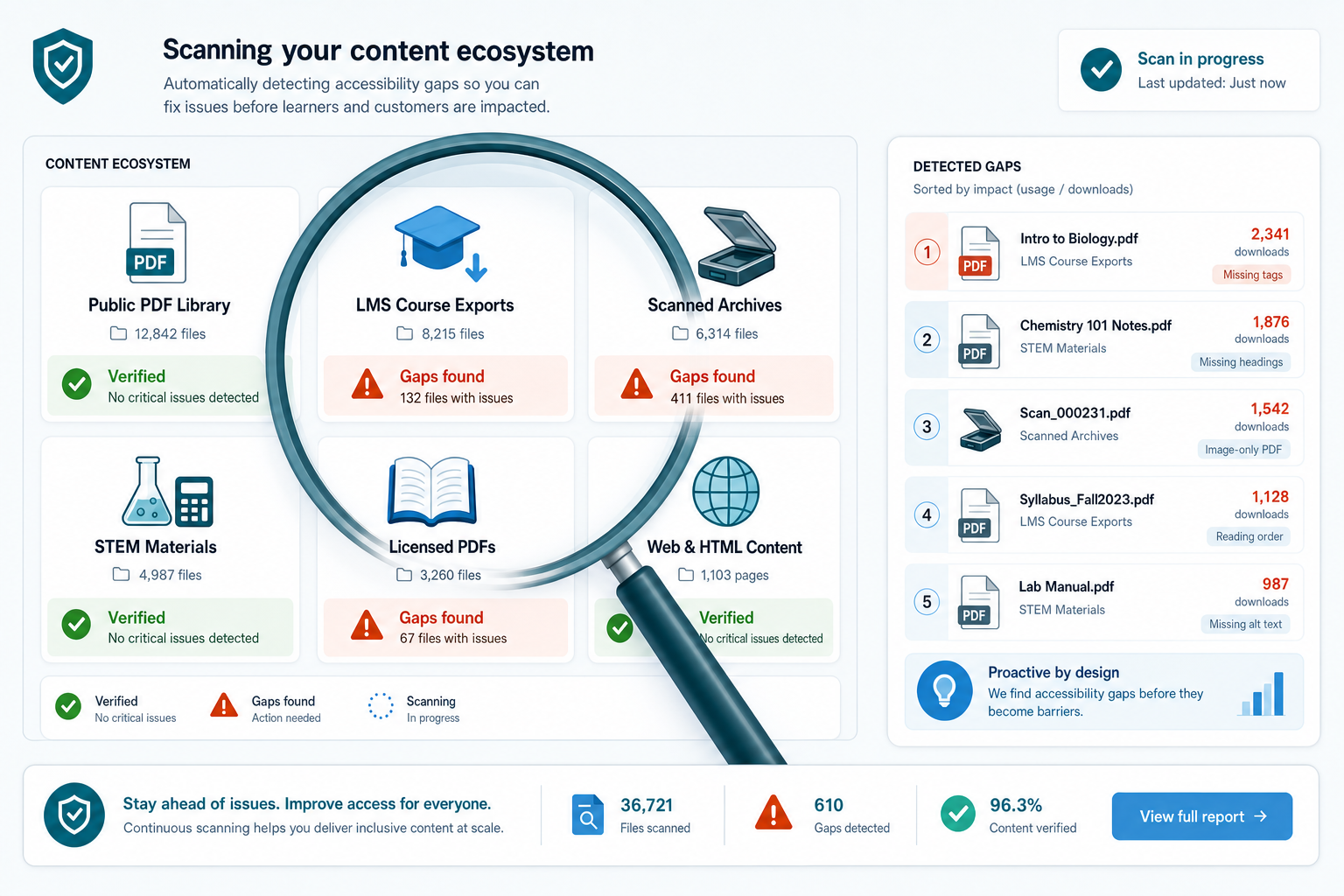
Reactive vs. proactive programs
| Reactive | Proactive |
|---|---|
| Review findings drive the queue | Gap detection feeds the queue continuously |
| Remediation in crisis mode | Prioritized by risk and usage |
| No baseline inventory | Known conformance rate over time |
| VPAT assembled under deadline | Conformance docs maintained ongoing |
Reviews should confirm progress — not discover your backlog.
What to scan beyond the website
- Public PDF libraries (forms, policies, reports)
- LMS course exports and faculty uploads
- STEM materials (image math, undescribed diagrams)
- Scanned archives (image-only legacy content)
- Third-party licensed PDFs distributed as official materials
A web-only scanner cannot see most of this volume.
A practical prioritization framework
- Exposure — public-facing vs. internal-only
- Usage — download counts, enrollment reach, legal mandate
- Severity — an untagged scan vs. one missing icon alt text
- Complexity — STEM and nested tables last unless exposure is high
Feed ranked items into a single transformation queue with department ownership.
From detection to verified delivery
Gap detection without expert validation produces false confidence. Automated scans miss:
- Incorrect reading order with passing tag counts
- Meaningless alt text on complex figures
- Math presented as images
MorfAlign pairs WCAG 2.2 and Section 508 scanning with certified accessibility QA on transformation outputs — so detected gaps become verified fixes, not assumed fixes.
Metrics to track weekly
- Assets scanned (cumulative)
- Gaps by category (structure, alt text, math, tables)
- Items in transformation vs. verified
- Mean time from detection to verified delivery
What changes in your program tomorrow
Tomorrow: Run your top 25 most-downloaded public PDFs through any structural check available (structure panel, PAC, or platform scan). Sort failures by download frequency, not file size. That sorted list replaces "remediate alphabetically" as your queue order starting Monday.
Next step: Schedule a program review to map detection to transformation workflows on MorfAlign.