
Your team cannot manually remediate every faculty PDF this term — but the last bulk automation run that tagged a scanned STEM exam as one giant paragraph proved that speed without accountability is just faster failure.
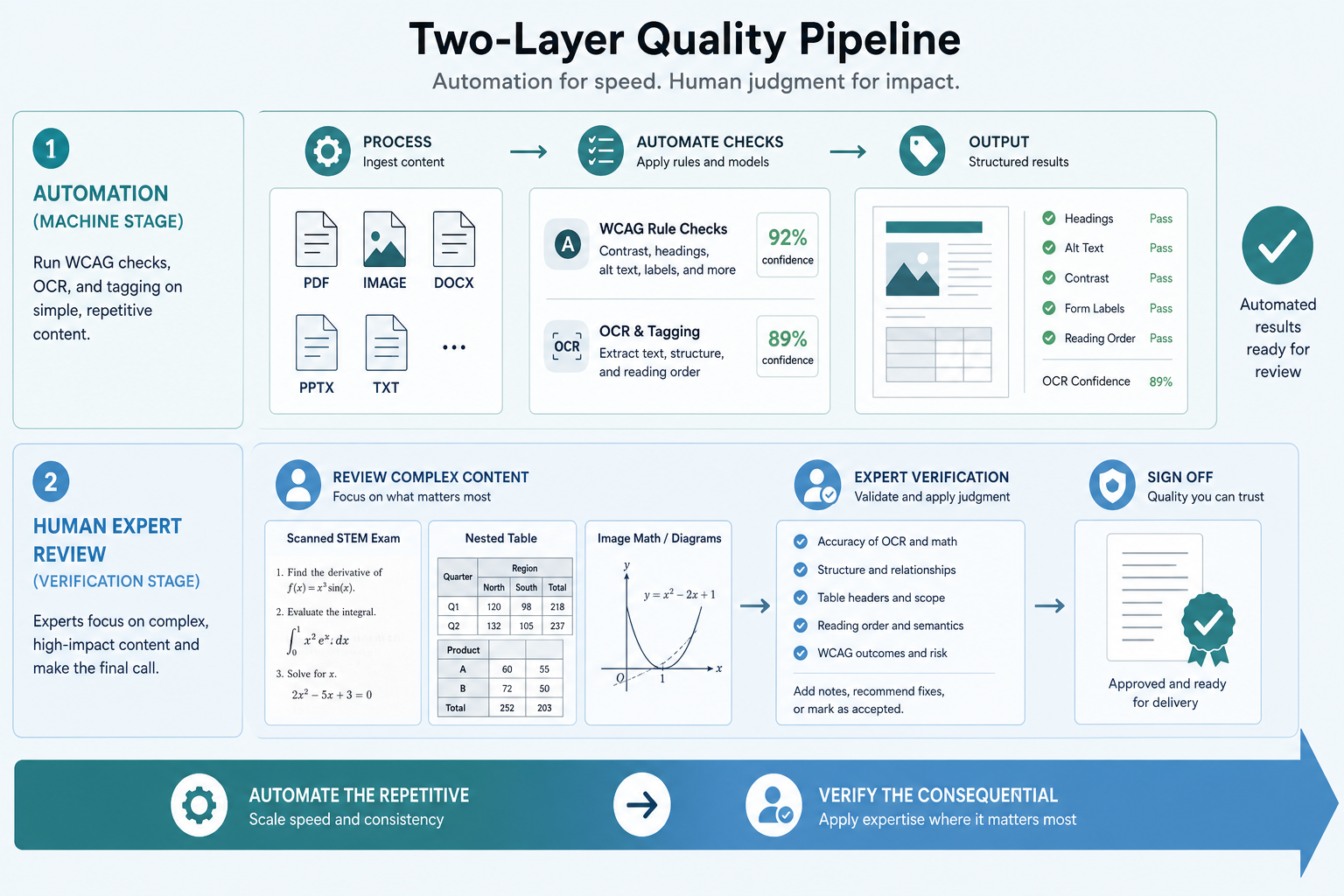
Real document accessibility compliance at scale is not a choice between people and machines. It is a division of labor: automate the repetitive, and route the consequential to expert review.
Why manual remediation burns out teams
- Rising LMS upload volume every semester
- STEM and scan-heavy content resisting quick fixes
- Flat headcount against expanding Title II expectations
Heroic manual production does not scale — but abdication to unchecked automation does not hold up either.
Where pure automation fails
| Content type | Automation failure |
|---|---|
| Scanned exams | OCR without reading-order repair |
| Nested tables | Header scope misassigned |
| Image math | Tagged as figures with empty alt |
| Multi-column layouts | Linearized in the wrong sequence |
| Complex charts | Generic "chart" alt text |
In education and government content these are majority failures — not rare exceptions.
The two-layer QA model
Layer 1 — Automated validation
- WCAG 2.2 rule checks
- PDF/UA structural validation
- OCR and tagging pipeline with confidence scoring
Layer 2 — Expert review. IAAP CPACC-certified specialists verify usability, not just rule pass; they sign off on the STEM, tables, and figures automation mishandles; and accountability stays traceable for review and student impact.
Responsible automation principles
- Never ship scan-heavy or STEM content on automation alone
- Log what the machine changed — reviewers need diffs, not blind trust
- Measure error rate by content class and adjust thresholds accordingly
- Keep students out of the QA loop — expert review is staff responsibility
Batch processing without losing quality
Morf Transformation supports batch pipelines (async processing for high volume) with expert accessibility QA on outputs — so agencies and universities clear backlogs without silent quality collapse.
What changes in your pipeline tomorrow
Tomorrow: Classify your queue into Tier A (born-digital, simple layout) and Tier B (scans, STEM, nested tables). Route Tier B to mandatory expert review before release — even if Tier A can move on automation with spot checks. That single routing rule prevents most student-facing failures.
Next step: Upload a complex sample and compare automated output vs. expert-reviewed delivery.