
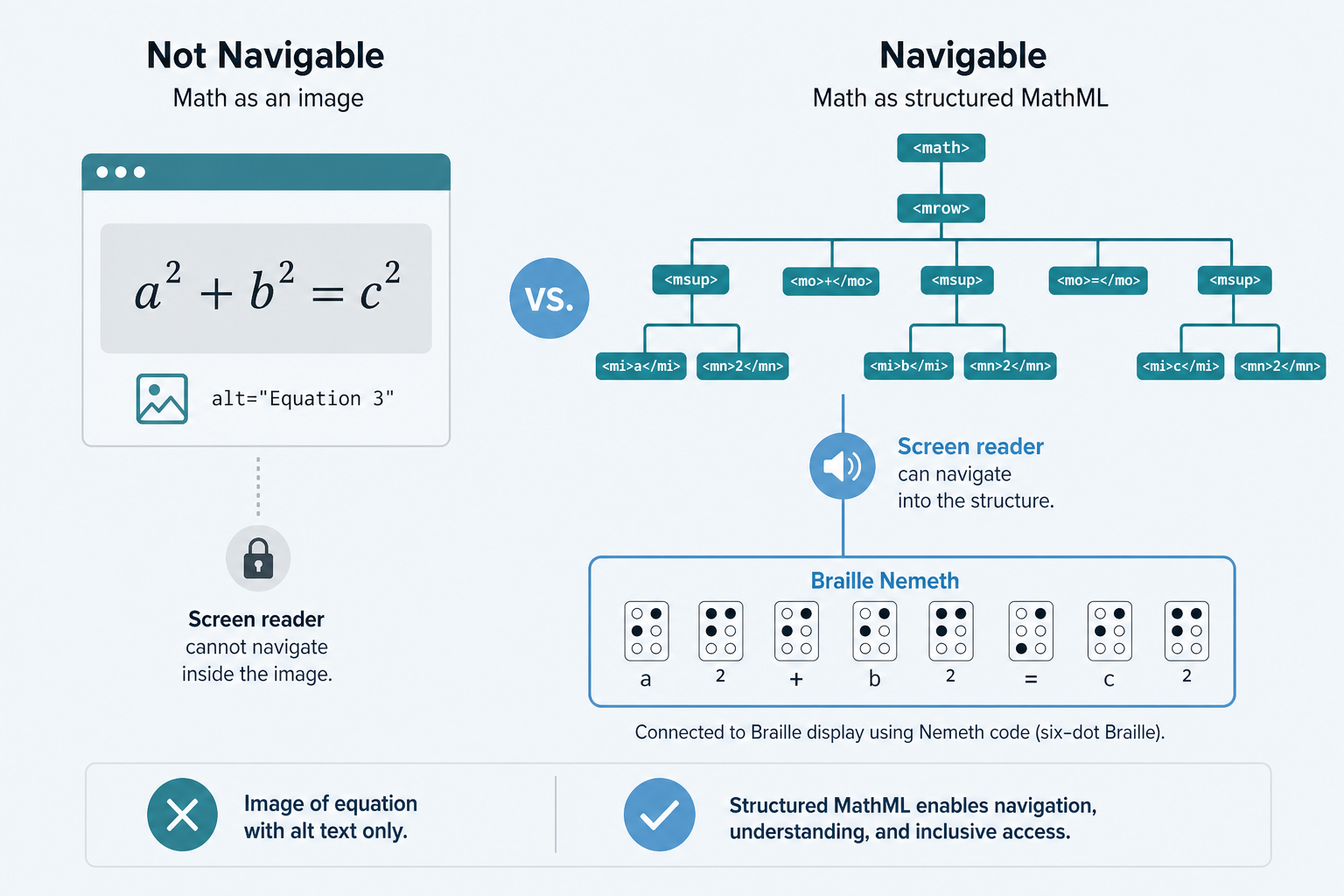
A calculus midterm can be "fully tagged" with alt text on every equation image — and still be unusable for a student who needs navigable math, because the image of an equation is not math.
This is where generic remediation quietly breaks. Real STEM accessibility depends on structural math in the source or output, not prose descriptions pasted into alt fields.
Where generic remediation stops
Bulk PDF tools excel at text blocks, simple figures, and heading tags. They break on:
- LaTeX or Equation Editor exports flattened to images
- Multi-step derivations where order and nesting matter
- Chemical structures and diagrams needing described geometry
- Charts with data series announced as undifferentiated graphics
- Nested tables spanning problem sets and answer keys
STEM is where checkbox accessibility ends.
MathML vs. alt text — the technical baseline
| Approach | Screen reader behavior | Braille output |
|---|---|---|
| Image + alt text "Equation 3" | Announces a label, not math | No Nemeth conversion path |
| Image + long description | Readable but not navigable | Manual transcription |
| MathML | Navigable formula structure | Convertible to Nemeth Braille |
Accessible equations require MathML (or equivalent structural math markup) in the source or remediated output.
Charts, diagrams, and complex tables
- Charts — data series need programmatic labels, not "bar chart" alt text
- Scientific diagrams — descriptions distinguish structure (cell walls, axes, vectors) from decoration
- Tables — problem/answer layouts need header scope; merged cells must not collapse reading order
Morf Transformation includes specialized math and image editors for content generic pipelines cannot repair automatically.
Nemeth Braille is not optional for math programs
Disability services teams producing BRF for STEM courses need Nemeth code for mathematical notation. Workflows that stop at HTML or tagged PDF without Nemeth paths leave Braille readers with incomplete course packs.
One structured source producing MathML + Nemeth BRF + tagged PDF is the operational target — not three manual rewrites.
Test with real AT, not export settings
- Navigate equations with a screen reader — can you move into the formula?
- Export BRF — does the math survive conversion?
- Spot-check one chart — are values and series distinguishable?
What changes in your pipeline tomorrow
Tomorrow: Pull one STEM PDF from your current semester queue. Count equations presented as images without MathML. That count is your manual transcription debt — flag those pages for structural math remediation before any alternate format production.
Next step: Upload a STEM sample — equations, charts, or nested tables — and evaluate MathML and Nemeth output.