
Disability services clears this week's alternate format requests while faculty upload next semester's untagged PDFs to Canvas — and no institutional system connects those two facts until the backlog doubles again.
That disconnect is the core problem in higher education accessibility compliance. The work is real, the people are capable, but responsibility is split across teams that never share a queue. Sustainable accessibility program management starts by connecting content intake, production, and reporting on one platform.
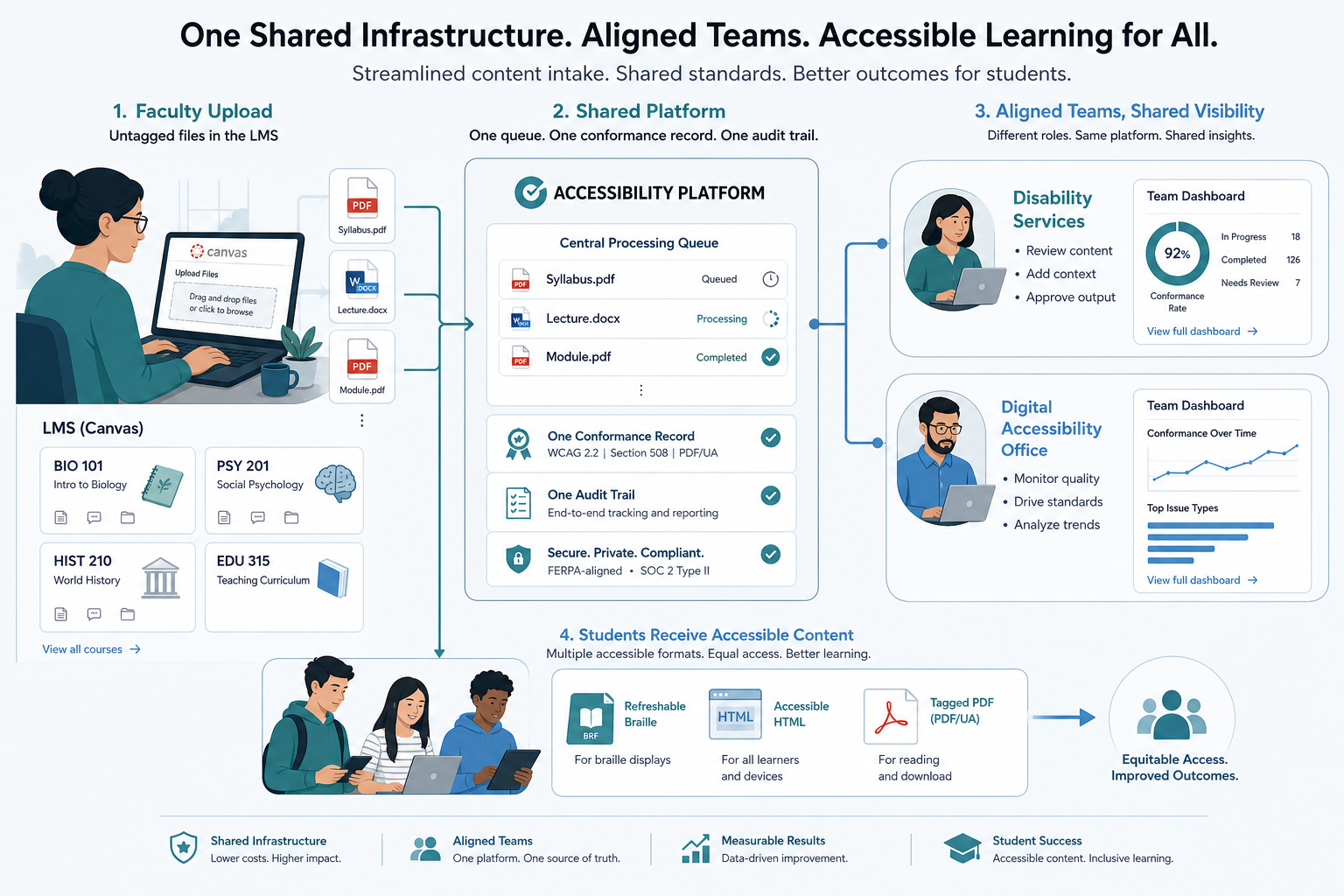
The higher-ed accessibility gap
Instructional materials fail at scale because ownership is split without shared infrastructure:
| Role | Typical focus | Gap |
|---|---|---|
| Disability services | Student requests, BRF/HTML production | Reactive queue; no faculty upstream control |
| Digital accessibility office | Web, procurement, policy | Limited visibility into LMS document volume |
| Faculty | Content creation | No structure requirements on uploads |
| IT / LMS admin | Platform uptime | Accessibility not in upload workflow |
Everyone is busy. No one owns the pipeline.
What drives volume every term
- Syllabus and reading packet surges — weeks 1 to 2
- LMS-native uploads — DOCX and PDF without tags
- STEM course packs — image math, undescribed diagrams
- Scanned readings — OCR-only "accessibility"
- Publisher PDFs — licensed materials with unknown conformance
A strong website program does not reduce this document inflow. Document accessibility compliance needs its own operating model.
Disability services and DAO working from one system
Programs that hold up over time align three layers of digital accessibility management:
- Digital accessibility office — program standards, gap detection, Title II reporting, vendor governance
- Disability services — student-facing delivery, format preferences, turnaround SLAs
- Shared platform — one queue, one conformance record, one audit trail
Parallel spreadsheets guarantee duplicate work and conflicting status.
LMS and batch workflows
- Canvas LTI — transform content inside existing course workflows
- Batch pipelines — process reading packets and departmental libraries asynchronously
- Expert QA — human verification on high-stakes exams and STEM
- Conformance tracking — leadership visibility without weekly manual reports
Explore sector detail: higher education solutions.
Outcomes at term scale
- Reduced alternate format turnaround via structure-first batch processing
- Instructional materials aligned with Title II program reporting
- Lower manual rework when BRF, HTML, and tagged PDF flow from one source
Morf's platform emerges from university and NIH/NSF research partnerships — designed for the content classes higher ed actually distributes, not demo PDFs.
What changes in your program tomorrow
Tomorrow: Schedule a 30-minute alignment meeting between your digital accessibility office and disability services with one agenda item — "What is our single source of truth for document conformance status?" If the answer is two systems or none, assign owners to define one shared queue both teams update by end of month.
Next step: Explore higher-ed solutions or contact Morf for an institutional workflow review.