
Agencies complete a Section 508 remediation sprint, declare victory, and upload new untagged scans to the public site the following month — because remediation was a project, not an operating model.
Durable government accessibility compliance depends on accessibility operations: repeatable steps that run every time content is published, not a one-time cleanup that decays the moment it ends.
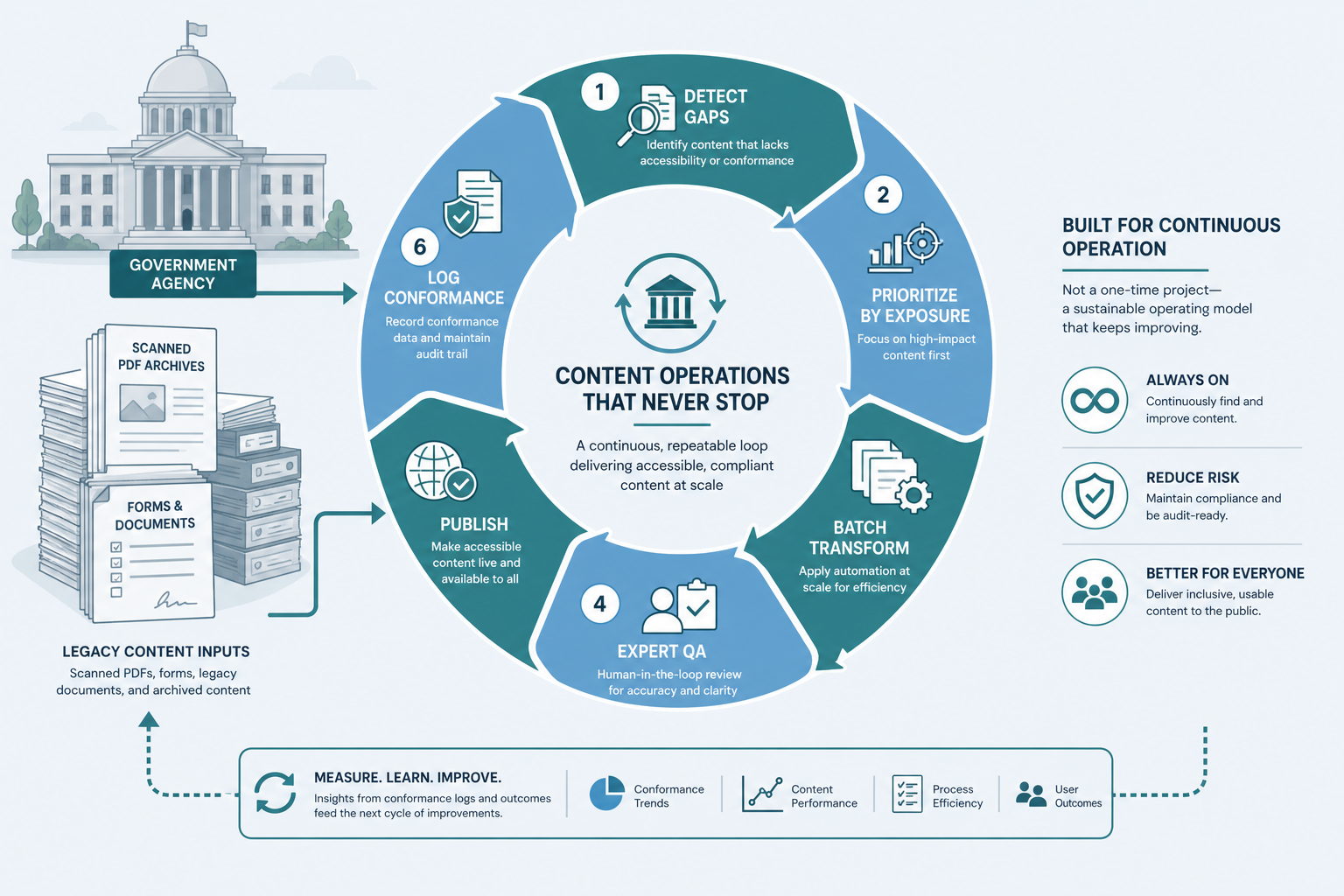
508 is continuous, not episodic
Section 508 applies to federal and federally funded ICT — including electronic documents and web content. Operational coverage requires:
- Inventory of public-facing content
- A transformation queue with clear ownership
- Verification against WCAG 2.2 AA and PDF/UA
- Monitoring as content publishes and updates
One-time vendor projects decay immediately without ongoing governance.
Legacy scans and public PDF libraries
Government backlogs cluster in:
- Image-only PDF archives (pre-digital records)
- Forms with fillable field accessibility gaps
- Policy and notice PDFs updated by non-technical staff
- Report tables spanning hundreds of pages
These assets do not appear in website crawls — they require document-specific detection and batch transformation.
Operational workflow — scan to proof
A repeatable pipeline for public-sector teams runs in one direction and then loops:
- Detect gaps across content types
- Prioritize by public exposure and usage
- Batch transform at volume
- Verify with expert QA
- Publish, then log conformance for the record
MorfAlign supports this loop with conformance tracking at each stage — not a black-box handoff.
Program leaders need central tracking
Program managers report to OIG, CIO councils, and executive steering committees. Sound accessibility compliance management gives them:
- Conformance rate trends (not point-in-time snapshots)
- Department-level accountability
- VPAT-ready documentation for public-facing systems and content
Fragmented remediation cannot produce executive-ready metrics.
Research-grade precision at operational scale
Morf's platform builds on 16 years of NIH and NSF-funded accessibility research — bringing institutional-grade structure repair and validation to government-scale volume through batch processing and API integration.
Sector workflows: Government solutions.
What changes in your operations tomorrow
Tomorrow: Identify your public content publish path — who uploads PDFs to the website, intranet, or records system? Insert one gate: no publish without a structural check on PDFs. Even a manual check at publish time stops the re-infection cycle that undoes remediation sprints.
Next step: Explore government solutions or contact Morf for Section 508 program design.